
Between selecting the desired slab stone at the showroom and installing it in your project, there is the critically important stage of transporting slab stone to the site. Whether you want to refresh a small courtyard or begin a large-scale landscaping project, moving these heavy and large-format stones is a significant challenge. This article covers the most important tips for safe slab stone transportation.
Between selecting the desired slab stone at stone showrooms and installing it in the exterior facade or various interior sections, there is the critically important stage of transporting the slab stone to the project site. It doesn't matter whether you want to refresh a small backyard courtyard or begin a major landscaping project — in either case, moving these heavy and large-format stones is a significant challenge. In this article we intend to acquaint you with the most important tips for moving and transporting slab stone. Stay with us.
Despite the many methods of moving slab stone, since these stones are very heavy and large-format, the condition for their safe and intact transfer is choosing the best transport method. A few methods of transporting slab stone are as follows.
A rolling stand is one of the simplest tools for moving heavy slabs. You simply need to lift the stone slightly at the start of the move so it rests on the sawhorse. The center of gravity of this tool is designed to keep the load stable during movement, and it has straps that secure the stone in place. If you want to know about lighting for slab stone, don't miss the article on the 4 main and important factors to observe in slab stone lighting.
Many people get creative when transporting slab stone and use a roller system with PVC or metal pipes for moving, which can work well if you set it up correctly and have a suitable surface for rolling.
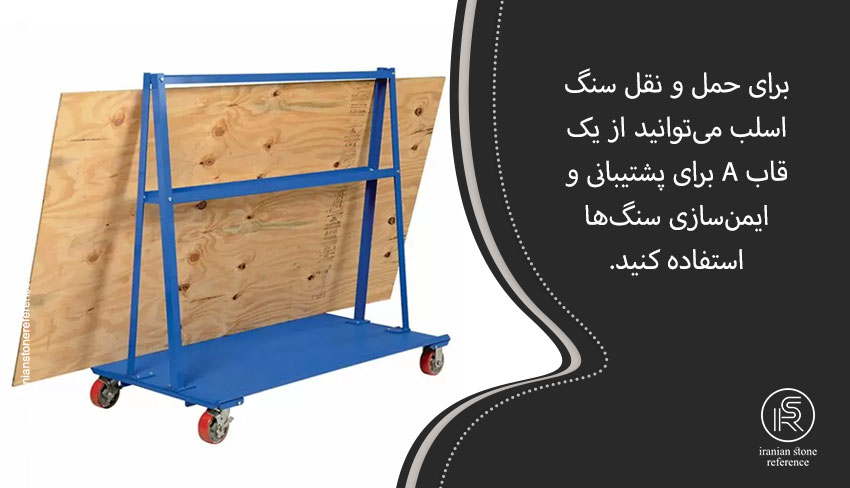
For transporting slab stone, you can use an A-frame to support and secure the stones. These frames are usually made of galvanized steel and are firmly welded to have a strong structure. They have a support at the bottom and back that bears the weight of the load. However, sometimes the stones shift on the frame during movement, causing breakage or at least cracking. To protect and separate the slab panels from the frame and from each other, you can use padding such as moving blankets, or use straps and cargo clamps to secure the slab stone on the frame so it does not slide.
We talked about the special frames and stands that move heavy slabs. But let's see how loading heavy slabs onto these wooden or metal frames should be done to protect the stone from origin to destination. In the first stage, you must measure the stone's dimensions and wrap it in a protective layer such as a blanket to protect it against impact. After choosing the transport tool, pad the bottom of it so that the stones do not slide on the stand during movement. Then gently place the slab panels on the stand and always get help from someone at this stage. Depending on what transport tool you choose, decide on the type of stone arrangement (vertical or horizontal) and secure them with straps.
To transport slab stone to a location where using rolling stands is not possible, rotate the stone on its heel axis and slowly move it in the direction you want. First take one end of the stone and push it forward; then pick up the trailing end of the stone and pull it forward. Note that this requires lifting and physical effort and will definitely damage the surface. Therefore, during the move, as much as possible be careful of yourself and the surface on which you are moving the stone.
One of the most important tips for transporting slab stone is the weather conditions on the day of moving. Under no circumstances transport stones on wet and rainy days or under direct sunlight. Hot or cold and freezing weather severely damages the stone and has a negative effect on its lifespan, durability, and beauty. If you have no choice but to transport slab stone in rainy weather, be sure to cover the load with polyethylene covers. For covering the corners and protruding parts of the stone you can also use polyethylene covers, burlap fabric, or narrow pieces of wood.
Moving large and heavy slab stones requires a considerable expenditure of time and effort so that the stones ultimately arrive at their destination correctly and safely with the least possible damage. We recommend entrusting the transport of marble, quartz, and granite slabs to specialists in this work; but if you intend to take responsibility for transporting the slab stone to the project site yourself, keep these important tips and guidelines in mind and follow them to the letter. We hope that after reading this article no questions about transporting slab stone remain unanswered in your mind.
← Back to Stone Knowledge