
Industry · 6 min read · February 23, 2023
Everything You Need to Know About Slab Stone on Cabinets
The kitchen is the heart of every home and the cabinet is the heart of every kitchen. Since approximately 90 percent of kitchen operations take place on the cabinet surface — which is always moist — choosing the right cabinet surface material is a decision that deserves careful thought. Slab stone on cabinets offers both beauty and durability in every design and color imaginable.
The kitchen is the heart of every home and the cabinet is the heart of every kitchen. Since approximately 90 percent of kitchen operations take place on the cabinet surface, the top surface is always moist and the interior space is always dark — making the choice of cabinet material a decision you must think more carefully about. Our recommendation is to use slab stone on the cabinet. These enormous stone panels in various designs and colors are produced specifically for cabinet surfaces and released to the market. From sky-blue granite slabs to wine-colored quartzite or beige travertine — whatever design and color you want is available to you. In this article we intend to discuss the types of slab stone suitable for cabinets. We recommend staying with us to the end of this article.
No matter how careful you are about the kitchen and the area around the cabinets, this environment is always moist and there is nothing much you can do about it. There is always some moisture around the sinks and this same moisture limits our choice of cabinet surface material. The surface we choose must be completely resistant to heat, constant moisture, and scratching from knives and other utensils. Therefore, porous and non-durable surfaces such as wood are not suitable options for this use. In contrast, slab stone — which offers both beauty and durability — is one of the most popular choices for cabinet countertop surfaces. But an important question: with so many different stones available in the market, which type is best for the cabinet surface?
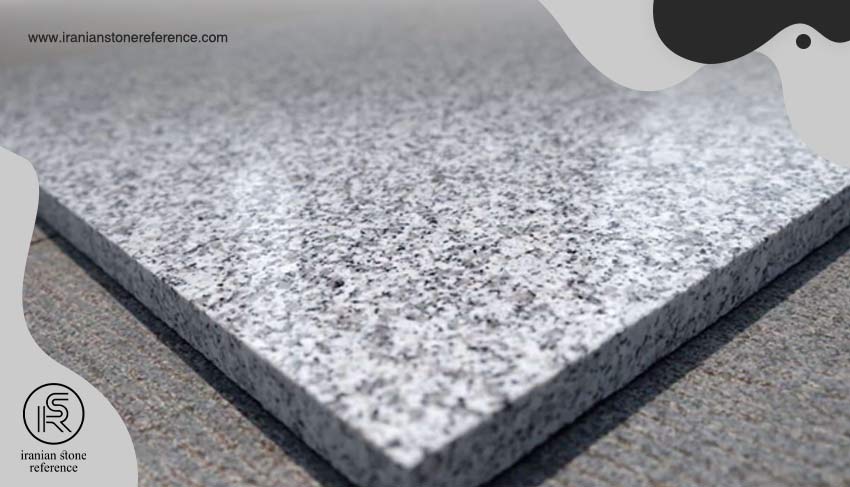
If you have at least a passing acquaintance with granite stone, you will not be surprised to see its name at the top of our list. Granite has long been the first priority of designers and builders for cabinet surfaces due to its beauty and durability. In simpler and more certain terms, there is no better alternative for this section of the kitchen. Granite is an igneous stone that forms completely naturally in the depths of the earth's crust under extraordinary pressure and temperatures exceeding 2,300 degrees Fahrenheit, and has excellent resistance to heat. In the past this stone was found only in luxury and grand buildings due to its high cost; but today it is an extremely common stone, especially for kitchen countertops.
The advantages of granite for kitchen countertops include: nearly impervious to heat; very strong and durable; adds value to home decor; high color variety; requires no maintenance and repair if a sealer is used. The disadvantages include: very expensive; possibility of cracking under pressure or incorrect installation; dulls knives (if food is cut directly on this stone); requires sealing.
Quartzite, just like granite, is a natural stone that has both a special beauty and good durability for a high-impact surface like a cabinet top. Of course, one notable advantage of this stone over granite is that it has higher density and for this reason shows greater resistance to scratching, staining, or abrasion.
The advantages of quartzite include: easy maintenance without the need for sealing; uniform stone without porosity, grooves, or gaps; can be custom-made in any size and shape; resistant to staining and impervious to heat and acid.
Crystal slab undergoes recrystallization due to thermal pressure from magma injection and has a crystalline grade that is visible to the naked eye. This is precisely why it is named crystal — because of those crystalline grains. Of course, since this slab stone on a cabinet produces a sound similar to porcelain dishware, it is more commonly known in Iran as "porcelain stone." This beautiful stone is found in the market in dark to light grey backgrounds with black and yellow veining and is among the most popular.
The advantages of crystal stone include: excellent resistance to kitchen temperature changes; does not absorb heat; excellent resistance to water and acidic material penetration; excellent resistance to impact; reasonable price.
The disadvantages of crystal stone include: lack of great variety in design and color; being left behind in modern design and so to speak going out of fashion.
Marble is known to all of us — an extremely popular and reputable stone that has been used for centuries in classical sculpture and as one of the luxurious building materials. For some people the concept of "luxurious" is inextricably linked with marble. This metamorphic stone forms completely naturally under conditions where limestone or dolomite is exposed to intense pressure. The impurities in this stone create various colors and styles that satisfy any taste. Marble stone can be formed in very diverse colors and styles (more than 250 options as offered by Opuston), which contributes to its desirability as a design element. However, this natural stone compared to other stones is highly porous and susceptible to staining and requires proper sealing. It is also highly susceptible to etching from acidic substances — a very important point for kitchen use.
← Back to Stone Knowledge