
Industry · 5 min read · June 3, 2023
Key Applications of Slab Stone in Building Interior Facades
Slab stone has been among the first choices of architects and interior designers since its introduction to the market, and its popularity has never waned. Its breathtaking beauty, polished surface, excellent strength, easy installation, and the wide variety of designs and colors available make it the go-to material for almost every residential project — from flooring and wall cladding to cabinet surfaces and TV walls.
Slab stone has been among the first choices of architects and building interior designers since its introduction to the market, and its popularity has never wavered. This widespread popularity is certainly not unrelated to its breathtaking beauty, polished and smooth surface, stone strength and resistance, easy installation, and great variety of design and color available in the market. For this reason it is used in almost all residential projects — as flooring, hall wall cladding, cabinet surface, counter, dining table, TV wall, and more. In this article we intend to discuss slab stone in building interior facades and the most popular slab stones in the Iranian market. Stay with us.
A slab stone is a large, flat stone panel of relatively small thickness that is generally used as floor paving, wall and ceiling cladding in the interior space of buildings. But the beauty and durability of these stones can also be used for other purposes such as fireplace base, countertop surface, kitchen cabinet, or other sections of the home. The most widely used slabs in the construction industry come from the marble, granite, limestone, quartzite, travertine, and onyx families, which due to their variety of finishes are released to the market with uneven or polished surfaces. However, marble and granite still hold the lead in terms of popularity in the Iranian market.
Slab stone has applications in the design and construction of virtually any point in a building's interior space you can imagine — from counter and flooring to bathroom, hallway, and kitchen. Its most common application is for wall, ceiling, and floor cladding of buildings. Of course, the characteristics of the chosen stone, such as fire resistance, water resistance, and environmental temperature change resistance, determine its precise application.
Using slab stone for interior wall cladding multiplies the authenticity of the environment several times over. More importantly, stone walls are extremely resistant to harsh weather conditions, require minimal maintenance, and do not burn easily. Also, if you use natural slabs, their quality and durability actually increases over time! The variety of design and color of these stones gives the architect freedom for a cohesive design compatible with other decorative elements of the home, and this is the most important advantage of using slab stone in building interior facades. You can stone-clad all the walls of a large space like the reception room or living room, or by stone-cladding some of the walls, create an attractive accent wall.
Flooring — whether in residential or commercial buildings — is always exposed to foot traffic and impact. As a result, it must be strong and durable to remain intact for years and not crack or break from constant use. Slab stone is one of the market's most popular flooring options with the least cleaning hassle. It easily becomes clean and shiny with a cloth and dust particles do not remain on it. Using slab stone as flooring has another advantage — it keeps the indoor air cool. Therefore it can be used with confidence in areas with warm climates.
Slab stone, cut in large and shaped dimensions and released to the market, is widely used in modern decorating design for building new furniture. These stones can be used for covering the surface above sinks, bathtubs, coffee tables, and the chairs around them, and in this way the natural beauty of luxurious stones like marble and onyx can be enjoyed in the classic design of the interior space.
One of the most interesting interior design ideas is using natural granite, limestone, and Kodapa slabs for building shelving and bookcases. Various natural stones can be used for constructing shelves and cabinets and placing them in a cozy corner of the living room or kitchen space. If you use granite and quartz slabs, due to their non-porous structure you will have less trouble maintaining and cleaning them.
Another application of slab stone in building interior facades is constructing modern and minimal dining tables. The variety of stone designs and colors gives the designer the freedom to make the best and most appropriate choice. Although its price is somewhat higher compared to other types of tables, its very long durability and longevity is definitely worth the investment.
In recent years, the TV wall — the wall behind the television — has been one of the most important elements of modern interior decorating design, and most designers use natural slab stones for covering this space. A stone like marble that allows light to pass through it, so that LED panels can be installed behind it to further enhance the appearance of this part of the home. Of course, many people are fans of book match and four match designs for the wall behind the television or the accent wall of the living room and reception room, which are made with patterned slab stones.
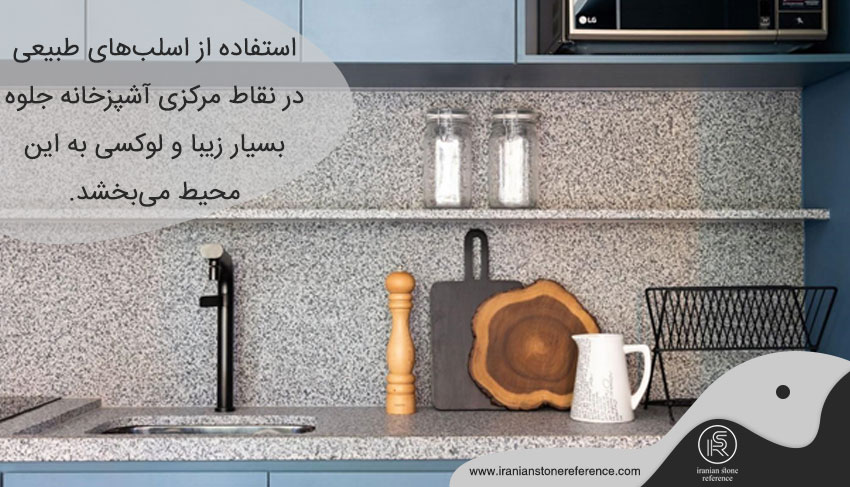
The application of slab stone in the kitchen space is endless. Many people prefer to cover the entire kitchen space with their desired slab stone so they don't have to deal with choosing different stones for the floor, ceiling, and walls. Alongside that, some people prefer to use shaped slabs only for the cabinet surface, counter, open counter, kitchen island, backsplash, or the wall between cabinets, and use different materials for the remaining sections. Using natural slabs in central kitchen points gives this environment a very beautiful and luxurious appearance. If your kitchen does not have good natural light, you can use light-colored slab stones with dark veining to compensate for the ambient light, making the space appear larger and brighter at the same time.
One application of slab stone in building interior facades is its use in the bathroom and restroom of residential and commercial projects. The exemplary durability and longevity of slab stone allows us to use it in a busy and always-humid environment like the bathroom without worrying about damage over time. The beautiful appearance of some natural and artificial slab stones — especially when executed in book match or four match layouts — in proportion to the color of fixtures and other decorative elements of this section, imparts extraordinary beauty to this part of the home. Of course, apart from the stone's durability against moisture, before making a decision you must pay attention to the slipperiness of the stone surface in humid environments.
In large spaces such as kitchens, entrance hallways, or master bedrooms, some of the walls are usually designed and decorated with a different color or wallpaper to create a distinctive appearance. But paint and wallpaper do not last long and at the same time have high maintenance and repair costs — especially in high-traffic and always-humid areas that need repainting several times a year. Fortunately, the various slab stones available on the market are released for different sections of a building's interior facade according to their degree of hardness and porosity. The most well-known of them are marble, granite, onyx, quartzite, travertine, and limestone.
← Back to Stone Knowledge