
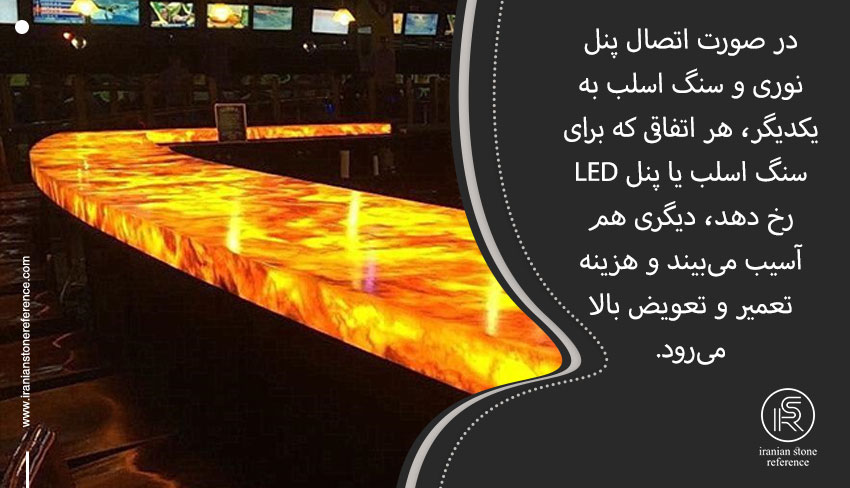
The natural translucency of certain stones allows designers to create stunning backlit installations impossible to achieve with any other material. Slab stone backlighting has become enormously popular in modern interiors, used in walls, kitchen countertops, bathrooms, and narrow corridors. This article covers the four critical factors you must consider for successful slab stone lighting.
The natural translucency of certain stones allows us to create a spectacular backlit scene impossible to achieve with other natural or artificial stones. This dazzling lighting technique has become enormously popular in modern interior design and is widely used in walls, kitchen countertops, bathrooms, and narrow hallways. In most cases, marble, onyx, quartzite, and granites with semi-translucent quartz crystals are chosen for backlighting. In this article we will discuss the important considerations for slab stone backlighting.
The more translucent the chosen slab stone, the better its light-diffusion performance. It is best to look at stones from the marble, quartzite, onyx, granite, and even agate families, which offer a wide variety of designs and colors. At the same time, pay attention to the dimensions and thickness of the selected stone. For natural stones, slab thickness should not exceed 2 cm, and it is preferable to choose a stone with large dimensions. Otherwise, the light transmission will not achieve the beauty you envision. Some veins and colors may not even be visible. Therefore, it is best to verify the stone's translucency using a flashlight at the time of purchase.
One of the important considerations in slab stone lighting is the lighting method and the use of an appropriate light source, since it is the light source that ultimately guarantees the level of light diffusion and, consequently, the final beauty and appeal of the installation. In today's market, the best choice for designers is the use of LED panels, also known as light panels — thin sheets packed with LED bulbs placed side by side instead of old filament bulbs. The light diffusion of these panels is excellent and their steady, uniform illumination radiates across the stone surface in the best possible way. With this type of light source you can also be confident about longevity for many years to come.
You may ask whether the light panel and slab stone can be connected directly to each other. The answer is no: if the LED panel and slab stone are attached to each other, any damage that occurs to either one will also affect the other and will increase repair and replacement costs. The distance between the two depends on the type of stone chosen and the type of LED panel. Some stones require a greater distance and some a smaller one. Sometimes placing the stone farther from the source results in less brightness but more uniformity. In general, this distance must be set at a specific amount to provide the stone with consistent illumination.
For slab stone backlighting installations, always choose moisture-resistant stones that can be used in humid environments such as bathrooms and pools without deteriorating over time. In addition, pay attention to the flexibility of the slab stone. LED panels can be damaged by the slightest impact, so the chosen stone must have high flexibility against breakage and impact and must not be easily damaged, in order to act as a solid protective shield for the LED panel. This flexibility and moisture resistance of the slab stone gives the designer freedom to execute backlighting in various interior and exterior sections of the building.
Slab stone backlighting is one of the newest interior design techniques, and if executed correctly with all the points we have mentioned observed, the result is beautiful and lasting. We recommend choosing light-transmitting stones such as marble and onyx for backlighting, as they have appropriate translucency. Next, considering the dimensions and thickness of your chosen stone, explore the latest ideas and best design models to select the most suitable option for your residential or commercial project.
← Back to Stone Knowledge