
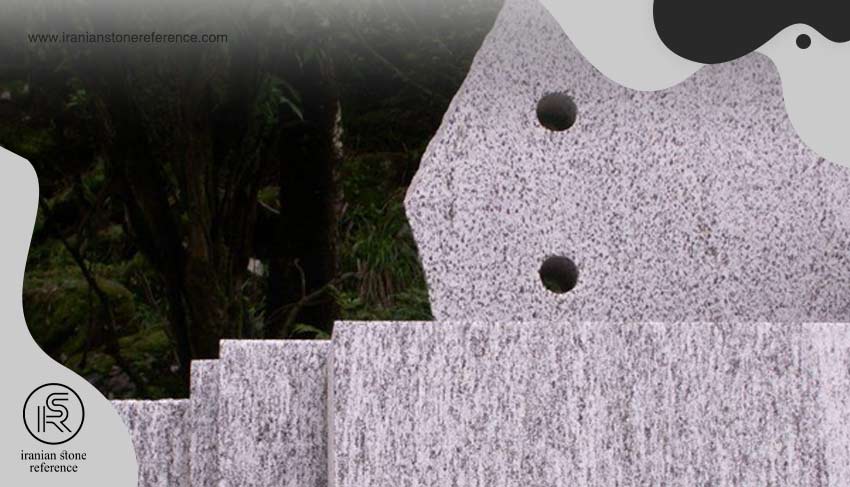
Granite slab stone has been making its way into luxury homes and commercial facilities for centuries, used in every corner of the home from kitchen countertops to flooring and wall cladding. Granite slabs are available in a wide range of designs and colors at affordable prices. This guide covers everything you need to know about granite slab stone.
Granite slab stone has been making its way into luxury homes and commercial facilities for centuries due to its beauty, elegance, and excellent performance in building reinforcement, and is used in every corner of the home — from kitchen countertops to flooring and wall cladding. Granite slabs are released to the market in a wide range of designs and different colors at affordable prices. Stay with us as we discuss at length the outstanding characteristics of these stones, their applications, and their advantages and disadvantages.
Granite is mainly composed of quartz, orthoclase or microcline, and mica, and is an ordinary, granular, and extremely hard igneous stone. This stone was used from ancient times as a strong building material and structures built with it had long lifespans. This durable material is widely used in the construction industry for kitchen countertops, flooring, and walls, as no pollutants are released during the production of its panels and it causes the least possible damage to the environment. The magical granite stone is cut with utmost precision into flat sheets and released to the market as black, green, grey, brown, or red granite slabs.
The first stage of granite slab stone production is the extraction of raw granite blocks. Mining companies extract and blast raw granites with powerful machines. Freshly extracted granite does not have a smooth surface — it is therefore sent to slab manufacturing workshops to be cut and have its surface finished using milling cutters and other powerful tools. After milling, the granite slab stone will be ready for dispatch to stone showrooms.
Granite slab can be divided into four categories based on the type of stone surface finish: Tooled finish: the surface of this type of granite is rough and the tooled grains are felt on it. Machined finish: the relatively smooth surface of this granite type is achieved with a finishing machine and the grains are placed parallel to each other. Rough finish: this type of granite has a uniform surface after the completion of grinding operations, but is not glossy. Polished finish: the surface of this granite after finishing has a bright color, its crystals are visible, and it can be like a mirror surface.
The most prominent characteristics of granite are as follows: Granite has a decorative aspect. The color of this stone is primarily determined by the dark mica, the color of the quartz syenite sand, and the dark-colored mineral; but it is usually black, red, brown, grey, and dark green and after finishing — due to the beautiful grains and varied colors — it reveals its true appearance. Granite has extreme hardness and high abrasion resistance. Due to lower porosity, this stone has lower water absorption and is very resistant to weather changes. Granite, due to its SiO2 chemical composition, has high acid resistance and excellent resistance to erosion. Granite slab cannot withstand fire and breaks and disintegrates in a fire.
The standard size of granite slab stone is between 122×61 cm and 274×122 cm. The thickness of this stone, depending on its length and breathing capacity, is considered to be between 18 and 40 mm.
Specific dimensions of granite slab in the Iranian and international markets are usually known as excellent coverage for kitchen countertops or office environments, shelves, tables, and benches, and have gained great popularity in these applications. Granite slab lends a beautiful appearance to the bedroom space and due to negligible water absorption in humid bathroom environments, door and window frames, niches, and cornices it is a beautiful yet resistant element. Many architects use this stone as a decorative element in the design of contemporary-themed kitchens and benefit from its breathtaking beauty. Natural granite is mainly used in large buildings or projects with luxurious interior and exterior decoration.
Installing granite slab requires very high precision and skill and those who take on this responsibility must have sufficient experience in this field. Under no circumstances should you install this stone yourself or entrust it to inexperienced individuals. The slab stone installation process requires careful attention, special tools, and professional knowledge. On the other hand, the great weight of this stone means the stonemason must have the necessary skill during installation, especially vertically. Remember that the more expensive the materials, the more expensive their installation costs will be.
Long lifespan and high structural integrity are among the impressive advantages of this breathtaking stone. These stones are also very resistant to erosion and can be confidently used as flooring in high-traffic areas. This stone withstands the worst and most severe weather conditions and does not easily crack from impact. Apart from all this, due to its beautiful appearance this stone can be used as a decorative element or as a facade and floor covering for the home. On the other hand, the most prominent disadvantages of granite slab stone include: one of granite's big disadvantages is the cost of purchasing and installing this stone. The long mortar application process and the extended time required for mortar adhesion slow down the implementation speed of granite significantly.
The price of granite slab stone is somewhat higher compared to other stones due to the relatively difficult production process. Of course, this price difference is absolutely no surprise given that this stone is natural and has very high resistance. In general, the price of granite slab stone is influenced by factors such as the dimensions and format of the stone, its quality grade, and the desired sort requested by the customer, and its installation cost is also relatively high given the high cost of the stone itself. If you are looking for more information in this area, be sure to contact specialists in this field to provide you with current market price information.
Sheet and piece granite slab stones are among the most popular and also the most abundant building stones, and are mostly used for greater interior and exterior facade effect. The beauty and durability of this natural stone are exemplary, but it is highly vulnerable to heat and must not be exposed to fire. If you have chosen this attractive stone to cover part of your home, rest assured that for many years you will benefit from its inherent positive characteristics such as resistance to corrosion, abrasion, impact, scratching, low water absorption, low porosity, and long lifespan.
← Back to Stone Knowledge