
Industry · 6 min read · March 4, 2023
Book Match and Four Match Stone: A Complete Guide
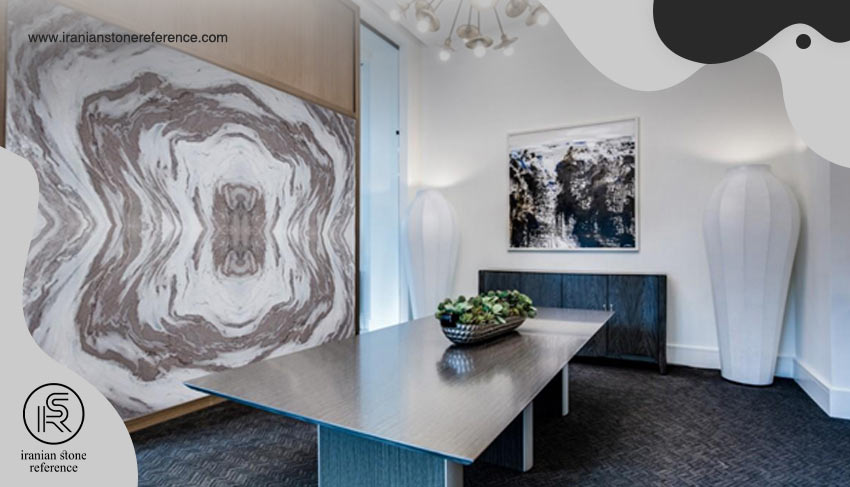
Book match and four match stones are the result of the most captivating stone processing technique, used in building facades, hotel flooring, and grand reception halls. When two or four slab stones are placed mirror-symmetrically, they create abstract patterns of breathtaking beauty that can transform any wall into a work of art.
Have you ever walked into a new office space or a friend's home and been astonished by an incredible painting on the wall — only to discover that this "painting" is actually an abstract pattern on stone, a modern decorative element that anyone can have in their room or even their bathroom? Book match and four match stones are the result of the most captivating stone processing method and are used in building facades, hotel flooring, and grand reception halls. Stay with us as we discuss both in detail.
Book match stone is the result of placing two slab stones in mirror symmetry, and four match stone is the result of placing four slab stones in mirror symmetry. Mirror symmetry means that symmetry between the stones is maintained to create a combination of symmetrical and complementary patterns with eye-catching beauty. The book match — or open book — pattern forms when two stone slabs are placed side by side and mirror each other's pattern in a chevron layout, resulting in a design resembling two butterfly wings, two halves of an apple, or an open book, where the pattern of one slab continues into the next. Similarly, quad match or four match stone is the result of combining four stone slabs symmetrically side by side in the shape of a beautiful and impressive diamond.
Book match and four match stones are produced and delivered to the market in slab dimensions. The most common slab format has a thickness of 2 to 3 cm and dimensions of 120 × 220 cm. In general, these stones have a length and width of over 70 cm.
The difference between book match and four match stones is evident from their names. In book match, the stone pattern is mirrored in pairs — or what is called a matched pair — and in four match it is repeated four times. Therefore, producing a book match design requires two slab stones and creating a four match design requires four slab stones. The designer can chain-repeat this pair or quartet in larger dimensions. It can therefore be concluded that the main difference between these two types of stone lies in their installation method on the wall.
But how are book match and four match stones produced? The first step is quarrying stone from mines. We will discuss which stones are most suitable for this purpose below. The extracted stone must have perpendicular dimensions and a complete pattern engraved on it so that its repetition on adjacent stones is beautiful and flawless. In the next step, the stones are bundled and transported to a stone-cutting factory to be sliced into slabs and ground on both sides. Note that if the block does not have standard perpendicular dimensions, it cannot be cut by the sawing machine. Finally, maintaining the order and mirror symmetry, they are installed in pairs or groups of four side by side to create a pattern.
The greatest application of these stones is for interior design beauty. This means they are considered a suitable option for interior spaces, especially for sections such as TV walls and TV rooms, bathroom vanities, or the home's accent wall that are more exposed to view. Book match and quad match are not suitable for small spaces — even if incorporated, they do not create the beautiful effect they should. That is why they are more commonly used in large, high-traffic locations to magnificently showcase the combination of nature and art. The lobby flooring or wall cladding of a building, entrance doors, reception hall paving, interior and exterior facades of a structure, and stairwell wall coverings between floors are the best places for book match and four match stone installation.
The price of stone is always directly related to the difficulty of its processing. Producing book match and four match stone requires modern cutting equipment. On the other hand, the large dimensions of these stones (imagine two or four slab stones placed side by side!) drive costs up considerably, which is no surprise. Beyond these two factors, the type of stone used and the attractiveness of the resulting pattern directly affect the price of these stones. Additionally, other items such as quarrying costs, grading, type of cut, and transportation costs must also be considered. This is why book match and quad match stones are most often seen in luxury buildings.
What advantages does processing book match and four match slabs have over older processing methods? The first and most important issue is the stone's structural integrity and increased longevity. If we look carefully at the stone preparation process — the use of modern cutting machines and grinding and polishing tools, and the fact that the slab stone is bundled with a backing mesh — this stone will be less susceptible to crumbling and cracking throughout its life and has excellent resistance to pressure. Book match and four match stone has a beautiful appearance and, with its distinctive and varied patterns, serves both as a decorative stone and makes selection easier for the buyer.
With one look at the appearance of these stones, we understand that the stone suitable for this type of processing must be patterned! Even if the pattern or design on the stone is not particularly beautiful, it may create an appealing design when stones are mirrored. However, the chosen stone cannot be completely plain and uniform, because mirroring two or four plain stones practically creates no special pattern and is not visually interesting. The next issue is the stone's ability to be cut into slab format. With these two considerations in mind, marble, travertine, certain types of marmorite, quartzite, and crystal with high contrast between the base color and the stone's pattern are the best options for this processing method. Limestone, granite, and sandstone are unsuitable candidates due to their simple, understated patterns.
After reading this article you now know that the book match or open-book design is achieved by placing two slab stones symmetrically side by side, as if a mirror were placed between the two stone slabs and reflected their patterns. If these same stones are placed quad match or four-at-a-time, by repeating and completing the pattern of one stone they create a breathtaking effect known as four match. Not every stone is suitable for book match and four match execution; that is why we most often see this pleasing repetition on natural stones such as marble, quartzite, and travertine, while limestone, granite, and sandstone are set aside due to the simple patterns they carry.
← Back to Stone Knowledge