
Travertine · 6 min read · March 4, 2023
Azna Stone: Advantages, Disadvantages, and Full Characteristics
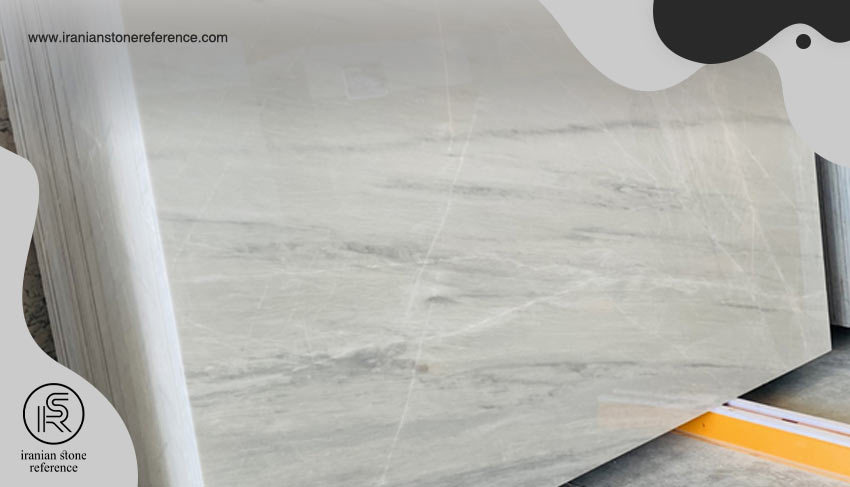
Azna stone is one of the world's most well-known and widely used crystal stones, bearing a very close visual resemblance to marble. Its brilliant transparency and exceptional light-reflectivity make it a popular and affordable alternative to marble in smaller projects. This article explores the characteristics, applications, advantages, disadvantages, and pricing of Azna crystal stone.
Azna stone is one of the world's most well-known and widely used crystal stones, bearing a very close visual resemblance to marble and for this reason enjoying great popularity as an affordable alternative to marble in smaller projects. The outstanding characteristic of this white stone with its irregular grey and black veining is its extremely high brilliance and transparency and exemplary light reflectivity, and it is used as flooring and wall cladding in all sections of a structure's design — from stairs and stairwells to exterior and interior facades. Stay with us as we discuss Azna porcelain stone, its characteristics, and applications in detail.
Azna porcelain stone is a type of calcareous dolomite and one of the most widely used building stones, processed into small tiles or large slabs and released to the market, with a strikingly beautiful design featuring a combination of white base and irregular grey and black lines. This high-quality crystal stone, like Aligudarz white porcelain stone, has a completely smooth, polished, and transparent surface that reflects light well and is considered one of the most expensive white porcelain stones. This stone is most often processed in Azna slab format and book match and four match designs, and is used for flooring or wall cladding in lobbies of grand halls and luxury buildings. Another thing to know about Azna is that despite its relatively high price, it is priced more favorably than comparable foreign stones.
In general, Azna stone has good resistance to abrasion, corrosion, and mild heat, and its porosity is very low with a smooth surface. This high-quality stone has very low water absorption and compared to similar foreign stones it has higher quality and better pricing. This beautiful stone with its density of grey and black color, due to its transparent and crystalline background, is perfectly suitable for low-light environments because that same brilliance and transparency provides sufficient light for the environment. The transparency of Azna crystal stone is due to the stone's grinding and polishing — the higher the quality of this process, the greater its transparency.
All the positive characteristics we listed for Azna stone in the previous section — including good resistance to abrasion, bending, corrosion, and mild heat — count among the advantages of Azna porcelain stone. The smooth surface and low porosity of this stone make cleaning and maintenance in busy, high-traffic environments easier, and another advantage is its excellent brilliance and transparency. The high compressive strength and specific gravity of this stone allow it to be polished in the best possible way. On the other hand, the high price of Azna porcelain stone is one of its biggest disadvantages. This beautiful stone comes in diverse dimensions and designs — the more elegant the designs and the larger the stone format, the higher its price increases proportionally.
The wide application of this stone in the construction industry stems from the advantages and positive characteristics we addressed in previous sections. Among the most important applications of this stone one can mention: floor covering for rooms, halls, and reception areas; interior building spaces; flooring for luxury halls; stair treads; under-stair cladding; stairwell wall cladding; entrances to luxury buildings; lobby walls and floors; hotels; shopping centers and luxury stores; kitchen countertops and public centers; interior kitchen spaces; bathroom and toilet wall and floor cladding; and even outdoor spaces such as landscaping and parking construction. Note that when using this stone outdoors, such as for landscaping and exterior building facades, more mortar must be used and the stone must be properly sealed to ensure waterproofing.
We said that this stone has a relatively high price, but it is relatively more expensive than comparable domestic and foreign alternatives. What are the factors affecting the price of Azna stone? The stone's appearance: the fewer, whiter, and more transparent lines on this stone, the higher its price — in other words, the higher the degree of purity of the stone, the more expensive it will be. Thickness and dimensions: the thickness of this stone is approximately 20 mm and it can be cut to thicknesses of approximately 16 and 19 mm. Thicknesses greater than 20 mm are mostly used for export and are more expensive. Larger dimensions of this stone command higher prices. Stone processing: the quality of stone processing is one of the effective factors in pricing.
White Azna stone — or Azna crystal stone — is one of the popular stones in the building construction industry and has maintained its position in this industry from the past with a great many fans. In Iran we introduce this stone as a type of porcelain stone, and the most well-known porcelain stone is known as Azna and Aligudarz porcelain, while internationally this same stone is famous as white marble. In this article we became familiar with the important characteristics of this stone, such as low water absorption and the capability of book match and four match execution, and learned in which sections of construction this stone has the most applications.
← Back to Stone Knowledge