
Industry · 6 min read · June 7, 2023
Artificial Stone for Cabinets: Complete Guide with Pros and Cons
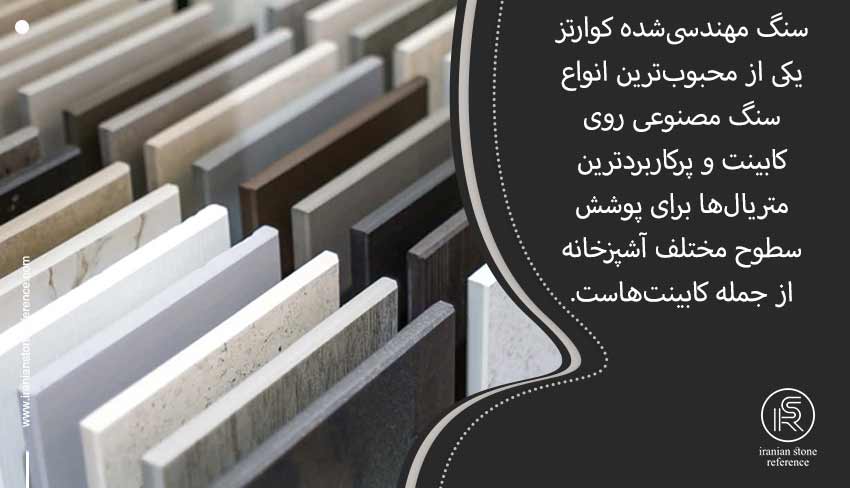
Since cabinets made their way into modern kitchen interior design, natural stones have been among the most popular countertop surfaces on the market. Today, the high price of natural slab panels alongside installation costs is driving many homeowners and interior designers toward engineered stones, which rival natural stones in beauty and structural integrity while offering greater variety and stain resistance.
Since cabinets made their way into modern kitchen interior design, natural stones have been among the most popular and sought-after surfaces on the market for covering cabinet tops. In today's market, the high price of natural slab panels alongside the high cost of fabrication and installation is driving many homeowners and interior designers toward using engineered (or artificial) stones. The beautiful reflection of light from these stones makes the kitchen space appear larger, and despite their visual appeal and inherent durability, they are not significantly inferior to the natural stones on the market. Stay with us through the rest of this article as we discuss in detail the types of artificial stone for cabinets and their specifics.
Artificial stone — or so-called engineered stone — is a cost-effective alternative to natural stones that makes achieving the beauty and appearance of natural slabs possible at a lower price. These stones are usually reinforced with polymer resins and are exceptionally resistant to tough stains, corrosion, and household traffic. Various types of these stones are available on the market, and by identifying them one can select the most suitable option for the kitchen decor. Note that some of these stones do not show good resistance to sudden temperature changes and cannot withstand hot pots and pans. But fortunately, with very low porosity and water absorption, they have good resistance to the penetration of liquids and bacteria.
Artificial stone panels are not extracted from quarries; rather, they are the result of combining natural stone powder with chemical materials such as resin by workers in a factory environment — yet their quality competes with natural stones on the market. After extracting natural stones such as granite and marble, these stones are ground and mixed with resin so that they have greater flexibility during molding into the desired design. Adding resin to the stone composition also significantly reduces its weight compared to natural slabs. In a word, engineered stones enter the market with enhanced characteristics and properties to deliver the highest quality at the lowest cost.
The most important advantages of using types of artificial stone on cabinets can be mentioned as follows.
Natural stones, just as they are extracted from quarries, enter the market without any additional compound additions. But artificial stones — which are the result of combining stone powder with other materials such as resin, colored glass, various metals, or mirrors — have greater beauty and appeal than natural stones and are more easily coordinated with the overall kitchen decor.
Some artificial stones such as quartz have extraordinary strength. Their hardness can even be compared to natural stones such as granite. Therefore one can be confident they will not crack easily, are resistant to scratching and cutting, and some of them are not damaged by heat. In general, engineered stones are usually structurally more uniform than natural stones and have greater strength.
One of the main disadvantages of using natural stone on cabinets is its porosity. Bacteria and microorganisms easily enter the cracks and pores of the stone and live there for a long time. Fortunately, the smooth and polished surface of artificial stones such as quartz does not allow any particle to penetrate the stone's structure and cleaning it is very easy. Therefore, if you are constantly handling raw vegetables, fish, or meat in the kitchen and chopping them on the cabinet surface, artificial stones are healthier and considerably more hygienic from a safety perspective.
Natural stones that are not properly sealed or whose sealing coating has deteriorated over time will be highly susceptible to staining from spilled oil, juice, and other food substances. One of the advantages of types of artificial stone on cabinets is that they resist the penetration of these materials well and have a longer lifespan compared to granite, marble, or even sandstones.
The last advantage of using engineered stones is their remarkable variety even in the Iranian market. These stones are available in a superb collection of various colors and designs, and since they are artificially produced with the addition of pigments, with a little searching you can choose a stone that suits your classic or modern kitchen. For more information about types of cabinet stone, read this article.
Some of the most popular types of artificial stone for cabinets in the Iranian market are as follows.
The first stone we will discuss is Corian artificial stone — the most famous and most popular engineered stone on the market, made from a combination of mineral materials (such as aluminum trihydrate and bauxite) and PMMA and ATH polymeric materials (usually acrylic polymer) in a ratio of 3 to 1. This stone is resistant to any chemical substance you can imagine and due to its integrated structure is very resistant to decay. This attractive stone makes cleaning and washing easy; however, one cannot rely on its resistance to impact and must watch it carefully. Also, color change in Corian panels over time and when exposed to temperature changes is unavoidable. But among its notable advantages, Corian can be cut and customized to any shape and size and is one of the easiest surfaces to repair.
Engineered quartz stone is one of the most popular types of artificial stone for cabinets and the most widely used material for covering various kitchen surfaces including cabinets. This beautiful stone is the result of combining a large portion of natural quartz stone powder with a small amount of polyester resin and pigment so that it enters the market with greater design and color variety. The presence of silica in the composition of artificial quartz stone transforms this stone into a hard and sturdy slab and an excellent choice for cabinet surfaces — one that resists heat, water penetration, and scratches well, easily bears heavy weight, and does not allow bacteria and harmful organisms to enter the stone's structure. If you choose quartz for your cabinet surface, you can rest assured of superior protection against staining and bacteria in the kitchen.
← Back to Stone Knowledge